Friday, March 19, 2021

The Final Learning Summaries (Retirement reflections, cont'd!)

So the last few classes in my Internet for Educators course - or #I4Ed as it is fondly known by many, is always a celebration of learning and connections. I ask the students to go back over the course and summarize, within a 4 minute time limit, the key ideas they learned through the course. The idea is to create the artifact and have a narrated (at least partly) video type presentation. The course is a seminar approach with several guest speakers so every person takes something different from the guests. We watch the videos together during the last few classes of the term. This year was the last time I will teach this course, I love teaching this course, it follows a rhizomatic approach and I bring in several other voices into the learning. 

A few students shared their creation in public, on YouTube or on their blog, here are a few:

An amazing (and time intensive I would think) summary by CD.

https://youtu.be/3FlVYRgUw8k

https://katrinanoel97.blogspot.com/2021/02/final-learning-reflection.html

https://youtu.be/B4yl5EVB0GE

Finally, a huge thank you to all the people who have dropped in over the years, in person and by video over the years. I also thank all the many  students who took the course, I think they enjoyed the course and had much to think about learn from the course.


Thursday, February 25, 2021

Passion Projects

Photo by Randalyn Hill on Unsplash
 So, teaching remotely this term, I wanted to mix things up. I decided I was not going to have zoom classes 4 hours a week. I know from having meetings over zoom for the past year, it can be mind numbing 😫, and sitting in front of screen for most of a day - and more so a week - is not good for anyone 😵. Since many of the other courses are fully on zoom - plus assignments outside of class -  I decided that I would use a combination of synchronous and asynchronous learning. One of the projects I decided on was a passion project. Everyone has things they wonder about and would like to learn about - well, they should anyway - so I took this idea, often used in K-12, and decided to go for it. The stipulations were straightforward - explore a topic related to using technology in education, make a plan, carry it out, learn, create some artifact to show the learning, reflect on the process and what you learned, share with at least one other classmate and with me.  Boom! Off they went, and the results were amazing and projects varied!  The students seemed to embrace the project, and many commented how they enjoyed doing it! My hope is that they can embrace such projects, or at least some inquiry learning, in their future classrooms. Some of the projects included:

  • Several on video production - using videos in math, or physical education, or ... 
  • A few looked into podcast creation and how it can be used in the classroom.
  • A few looked at various apps that could be used in different subject classrooms: math, geography, the gym, etc.
  • Some looked into coding, including making games, and robotics.
  • One looked at using VR in physical education.
  • Not to be left out, a number of music ed students looked into software for music recording or tutorials and creating amazing artifacts. One looked at using tiktok to deliver short tutorials.
  • Another looked at creating tours in google earth to use in geography courses.
  • Yet another collated and reviewed resources for teaching about reconciliation.
  • and on and on ...

This was one project I actually enjoyed going through and providing feedback - and there were over 60 of them! My own reflection was - why didn't I do this along time ago! I will not be teaching again after this term - as noted in earlier posts, I will soon retire, but I would keep using this project if I was still in the game, and I encourage any of you out there to give it a try, the results were well worth it!


Saturday, January 16, 2021

Sabbatical Over ... Back to Teaching

 So, the end of December marked the end of my half year sabbatical and return to the classroom. While the sabbatical was a good one - even if only half a year (I confess I certainly enjoyed the previous full year one more). I only took a half year since I am retiring in July and when taking a sabbatical, our CA states that you must come back for at least as long as the sabbatical, or pay back the salary earned. I did manage to finish some things up, have an article under review (on coding), and started a few other projects. One with a colleague who I have done collaborative work with often looking at educator use of social media during the covid school shut down last spring. Some interesting data, that is currently being analyzed so an article can be written before I retire! It was nice to do something on social media - it was the topic of my dissertation and other work I have done. Another project with 3 other colleagues is also going - I am the lead for now, but will hand it off when I leave. 

So, back to the classroom, I started in this profession in 1978, every year I had a course to teach - 27 years in a high school classroom, then as a Principal I taught a course as a sessional at BU. The only year without teaching was my full year sabbatical. This year, of course, is different. While I have taught several graduate courses online, all of our course are now online, including the undergrad courses. This winter I teach 2 sections of Using ICT in Ed for senior years and Internet for Educators. I am going to use an approach with synchronous classes using zoom and asynchronous 'classes'. I am so used to being in the classroom to demonstrate, have group work and discussions that this will be different. Even after 42 years, there is always something to learn ... in fact, I often tell my students that as a Principal I did not want teachers who thought they knew it all and nothing to learn about teaching/learning. I digress - I think 4 hours/ week on zoom (especially for all their courses) is mind numbing, so I will, for the mist part, go 2 hours on zoom and the rest asynchronous activities, with me available for individual meetings. To help demonstrate some ideas and apps I have been creating screencasts (Using Camtasia - it works very well - I should have been doing this for years and not waiting until my final 3 courses!).

In Internet for Ed I have always had guest speakers almost weekly, and this year is the same. I love the various voices and experience brought into the class, and the students blogs are always interesting as they reflect on each speaker's message. In the course we examine issues such as Internet (And issues - privacy etc.), literacy, identity, and citizenship, social media, online learning, and so on. 

In my ICT in Ed classes, I have a few projects that students can work on asynchronously. I will describe them in a later post, but one is a book club, and the other a 'passion project'. I hope that this will allow them to dig into topics of interest and allow some time off of zoom. Adapting and changing a course for online does pose challenges, luckily I have, as stated earlier, taught online before, but I am sure it is a lot of work for those new to it, especially for an audience not used to this mode of learning. It does requires more motivation and independence on the students part. This recent short article about a study of teachers about online learning points out what happens in many instances, and this is true not only of K-12, but also post-secondary, a tough thing to do when thrust into the situation with no previous experience, to be sure:

The report cites evidence that many teachers have tried to re-create the physical classroom experience for students by hosting long whole-group videoconference calls and sharing documents in the learning management system, approaches that are contrary to the advice of online learning experts.   (article on Education Week)

In a future post, I will describe some of the major projects mentioned above in a bit more detail. That is if I feel the urge to blog, something I have not been very good at doing, although I ask my students to do it in #I4Ed class ;-)

Saturday, August 1, 2020

Things I Have Been Reading

OK - small disclaimer - I have been reading lots more than this, but a few posts that have come across my screen I have found particularly interesting. I am also reading a eBook on a hobby I am into, a novel, a book on McLuhan and a few dozen research articles on computational thinking/coding for a research article I am wiring.  So these are of particular interest as I am conducting a new research project and as we contemplate moving our teaching online in the coming term. Lucky for me, my colleagues can do the work while i am on a half year sabbatical before teaching again in January. Saying that, my faculty is on pretty good condition since many of us (myself included) have been teaching online for some time - many of our graduate program courses are delivered this way. 

So ...

The first post is by Jesse Stommel ( I have been following his work for several years) and find his ideas interesting and agreeable to my own way of thinking, yet they also push my thinking as well. The post is here, and is about pedagogical models - and the problems with them.  This particular passage (among others) stood out to me:


Pedagogy is praxis, the intersection between the philosophy and practice of teaching. Best practices, which aim to standardize teaching and flatten the differences between students, are anathema to pedagogy.

and later,


There is no one-size-fits-all set of best practices for building a learning community, whether on-ground or online. And there is no secret mix of ingredients that create the perfect hybrid strategy.

The second post, related to the first, is by Maha Bali and is about the use of frameworks (especially for research - but more widely applicable than that). That post is here. The post is mainly about being critical when examining or using a framework, that context varies and we should really just develop our own framework - and be ready to change or discard it as well. Again, several passages leapt out at me, one is here,
... we should not assume that any set of practices have universal application, that each context is different and that we should not let the language of best practices make us forget the nuances of our own contexts.
I say the same for frameworks — as researchers, let’s challenge, mess up, allow emergence and ignore when appropriate; as educators, let’s make sure our students do not treat them as something to “follow” but something to look at occasionally and maybe get inspired by, but never get bogged down by.
Both of these are good reading.

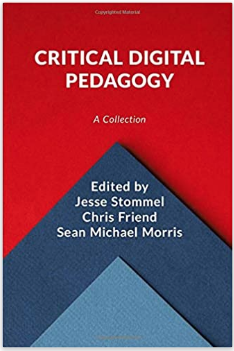
Also noted is that a new text of articles from Hybrid Pedagogy is out - I'm going to order it - always thought provoking reading - even for an old guy nearing the end of a long career like me.

Saturday, May 30, 2020

New Research Project ~ Manitoba Educators Wanted!

A colleague (Dr. J. Kirk) and I were going to examine how school administrators make use of social media, but put that off once the Covid-19 pandemic took hold of all of our lives. So we decided to re-focus on how certain Manitoba educators (K-12 teachers, school administrators, and division technology coordinators have used social media (in their professional lives) during the school shutdowns due to the pandemic. In order to make it quick and easy for stressed and overworked educators, we are using a simple survey approach. We feel the information will not only be interesting, but informative as the crisis persists.

If you are a MANITOBA educator in one of these groups - K-12 teacher (also including resource teacher, teacher-librarian, counsellor, etc), a school Principal or Vice-Principal, or a School Division Technology coordinator/leader. Please take a few minutes to complete our survey! 

https://bit.ly/BUsocialmedia_educator_survey

Thanks!

(PS - this research has been approved by the Brandon University Research Ethics Committee)

Friday, May 8, 2020

Curriculum & Pedagogy in the Pandemic

One thing this pandemic of school closures and learning at home has done is prompting a lot of thinking about pedagogy and curriculum. This was a point of a wide ranging discussion at a faculty council and department meeting recently. Such discussions are important at all levels as we move forward into these challenging times.

While parents and teachers are stressed, there are many comments on social media of kids pursuing passions, learning with families, and learning by doing. Many on various media talked about relaxing expectations a bit, assessing differently, using different tasks, and taking time to connect and slow down. Much of this was a way of coping and trying to keep stress levels for everyone manageable, but it does make us think about how we "do" education, to reflect on our pedagogy. How do we move forward? One thing that has certainly come to the fore is the use of various technologies - questions of platforms and apps and access are all important. This has highlighted the inequities in terms of access to the Internet, devices, and so on. It is important to improve connectivity across the land. This time also helps us realize the importance of humanity - the relationships, those things that really matter.

Hopefully it will help us all to take some time to contemplate the idea of curriculum - and the idea that we have to "cover" it all. I know I have already been considering my own courses and approaches (and I don't teach again until next January - sabbatical!
). While certain skills and knowledge are important, there are other things that deserve attention as well. We need to examine our conception of curriculum. As teachers at all levels struggle to enable learning without being 'together', our pedagogies are being taxed and hopefully we are reflecting on the strategies we use. When this is all over, we should take lessons learned and make positive changes to meet the challenges of the future.

Saturday, April 25, 2020

New eBook on Digital Literacy/Citizenship and Sustainability - Call for Proposals!

My friend and colleague, Dr. Rennie Redekopp, have decided to try to co-edit and publish a third eBook in our series looking at educational technology in Manitoba schools. Volumes 1 and 2 of our eBook series can be downloaded FREE here!

This one will tackle the broad topics of Digital Literacy, Citizenship, and sustainability.  As with our last book, the Manitoba Association for Computing Educators (ManACE) is supporting this endeavour. 

Here is the call from the ManACE newsletter:
----------------------------------

Are you a Manitoba teacher who addresses digital issues, sustainability, and/or global citizenship in your classroom/school? 
Want to share the good things you are doing and be an inspiration to others?

If so, consider sharing your work by contributing a chapter to an ebook of exemplary ideas and thinking from Manitoba schools. This purpose of this ebook is to share ideas of how concepts of digital/media literacy and/or digital citizenship are addressed in Manitoba schools and classrooms. For example, do you have any favorite lessons to address these topics? Do you use social media in a way to address issues of digital literacy, citizenship, sustainability, or social justice? When you have students do research online do you have mini lessons on evaluating sources? Do you infuse these concepts into your curriculum? How? Do you have any particularly good resources you use and are willing to share? Maybe you have been doing some deep thinking about these topics and have thoughts to share?

Due date for the proposal only: asap - submissions accepted until we receive a sufficient number to move ahead  
Please send a short description of your idea for submission. 
Include your name, school, and grade level(s). Note: collaborative pieces are also accepted!

---------------------------------------------------------------------------

If you are a Manitoba educator and you tackle any of these topics in your classroom/school/division - then consider contributing a piece - they do not have to be long! Let's share all the great things going on in Manitoba schools and help inspire others!

Friday, April 17, 2020

To err is human!

I have students in some of my courses blog and find it a great reflective tool for them - we both learn a lot. Saying that, I am not very good at blogging myself. I started strong when this blog was created for a course in my doctoral program, but have certainly not been consistent. I will post more about the blogging assignment in a later post though. I often find ideas I have had have been expressed so well by others, or some other reason, usually procrastination, keeps me from posting. I hope to change that a bit, this particular post I was going to write about one year ago. At the end of last May, ManACE (Manitoba Association for Computing Educators - a group of educators I belong to) held our annual general meeting. To add a twist we had a number of people present short narratives of times in our careers that we screwed up (read: f***ed up) and what we learned as a result. I was one of those presenters and I thought I would share that story here.

So this story goes way back, back to my first student teaching experience. I have learned a lot in my long career as an educator. If I retire when I hope to, it will be 43 years in classrooms, including grades K to 12 and post-secondary. 

35 mm film projector
Photo by 
Noom Peerapong on Unsplash
This lesson came early in my career, and was an important one for a not yet certified teacher. This took place in my first student teaching session, in November of 1977  (yes, 1977 - Star Wars: A New Hope Came to theatres, the Apple II just came out, the Concorde flew its first commercial flight, the space shuttle had its first test flight, Voyagers 1 and 2 launched, and Pierre Trudeau was the Prime Minister) this was a lesson I learned early that carried throughout my career. I was young - 22 years old - and pretty shy, introverted, and lacking self-confidence.


 I just finished my first term of teacher education, at that time a 1-year program, I knew how to use a 35 mm film projector and how to use an overhead projector - properly! I planned my lessons carefully, so I was set, or so I thought.


Time came for my first-ever lesson, it was grade 11 chemistry, and it went …  badly.  I was nervous beyond belief and totally f***** up, I was very embarrassed and disappointed with myself, so much so that I was ready to quit then and there.


Luckily, I had a great, caring, cooperating teacher.  He took me aside and settled me down. He offered support and encouragement, with a touch of firmness, and gave me some great advice. Don't be afraid to apologize and admit you screwed up, learn and grow from your mistakes. So I did just that. The next day, I talked to the class and apologized to my students, explaining my nervousness and suggested we just start again. The kids were very accepting, and they too were very supportive - another life lesson, ‘kids’ (teenagers) are generally great people if you treat them with respect. I restarted my lesson, which I had spent a lot of time planning with great demonstrations and so on, this time it went pretty well and I never looked back for the rest of that placement.


 So, the lessons learned:
 The main one is that teachers are human, we all make mistakes and screw up, it is important to realize this. We make the point often to our students, that we learn from mistakes and that is how we grow and learn. We try to get that message across to students, so we also need to learn to own up to our own mistakes, use them to model that it happens to everyone and it is okay to be vulnerable and admit those errors to our students, no matter their age.


 This experience also illustrates (as a teacher educator it is even more clear) the power of being a good mentor to students and beginning teachers. Without the support and guidance of that cooperating teacher long ago, I might have quit the profession and I believe that I have had a positive impact on many students as a classroom teacher, coach, school administrator, and now, as a teacher educator. So if we show patience and offer support our students may just stay on the path that makes the world a better place. 


Of course, as mentioned, over 42+ years I have made many mistakes. I have learned a lot and I've grown a lot - as a professional and as person. This lesson occurred early in my career and it's something I never forgotten. In future posts I will try to share some of the other things I have learned over my career. 

Thursday, April 16, 2020

Apollo 13 ~ 50 years on

Well -  it was the 50th anniversary of Apollo 13 and tomorrow (April 17) 50 years ago the crew returned safely to Earth. Although I am feeling my age a bit, it is still cool to have lived through many great events - both tragic and inspirational (my last post - almost a year ago - umm - was about Apollo 11). Of course, the saga of Apollo 13 was both tragic - the danger and loss of one moon landing, but inspirational in how the astronauts were brought back safely to Earth due to cool heads, never give up attitude, collaborative work, and smart people (ie science!). I recall those events, I was a space nerd and followed manned - and unmanned - space flight closely, and the suspense of this mission was certainly memorable. Last weekend, I celebrated this mission by watching the fantastic Tom Hanks movie - Apollo 13, and following some sites about the event. A few great links: https://apolloinrealtime.org/13/ and the BBC podcast, 13 minutes to the moon: https://www.bbc.co.uk/programmes/w13xttx2/episodes/downloads

Here is a NASA video about the Apollo 13 mission.

Tuesday, July 16, 2019

50 years


50 years ago today saw the launch of Apollo 11 and arguably the most significant
achievement of the 20th century, perhaps of human history. I was very fortunate
to be around during the days of Apollo as a young teenager. I vividly remember
following all the Apollo missions as an avid space and science geek. I watched
mesmerized as Eagle landed on the moon and Armstrong and Aldrin took those first
steps. The 60s were an amazing time to be alive, rock and roll was at its height with
the Beatles, the Stones, and so many more great artists. It was also the time of civil
rights and anti-war protests. I still remember seeing smoke curling up from downtown
Detroit in the summer of 1967, as I watched on the banks of the Detroit River from
Windsor. Despite the tumultuous times, Apollo 11 reverberated around the world and
was - and still is - an amazing accomplishment. To think the computers that got us there
and back were so much less powerful than the ones we carry in our pockets today.
I remember the entire family sitting around our TV set in our basement recreation room
watching spellbound and hearing those immortal words, “Houston, Tranquility base here,
the Eagle has landed." Here we are 50 years later and I get to look back on this
exciting event and enjoy the numerous documentaries and specials reliving the event,
all with the knowledge that I actually witnessed it as it occurred. It is amazing, and yet
demoralizing, that we have accomplished so much, yet have so far to go when we
look at the hatred and narrow mindedness exhibited by so many people who have
power. I hope the next 50 years sees us attack our current problems - climate change,
racism, etc. -  and conquer them as well.

One of many videos about Apollo online.


Friday, July 14, 2017

New eBook on Coding & Maker Spaces - Call for Proposals!

My colleague and friend, Dr. Rennie Redekopp, from the University of Manitoba, suggested that we co-edit a second book (see this post to download our first eBook - its FREE!). This one will tackle the maker and coding movement in Manitoba. As with our last book, the Manitoba Association for Computing Educators (ManACE) is supporting this endeavour. The call has been out for almost a month and and proposals are due August 1st (go here to see the call - and it includes a link to a google form that can be used for a proposal). So, if you are a Manitoba teacher and you do coding or computer science or have a maker space - then consider contributing a piece - they do not have to be long! Let's share all the great things going on in Manitoba schools and help inspire others!


Wednesday, March 29, 2017

Reflections on the School Year That Was

Last year I was on sabbatical so it was the first time in 38 years I have not been in a classroom. This year saw a few changes in my workload, as well as picking up some of the courses I have previously taught. I enjoyed the year out of the classroom - first one in 37 years or so, but I also enjoyed being back. I also think this year proved once again that a person should be always learning, and reflecting on that learning. I have always told my students (aspiring teachers) that as a former Principal, if a teacher thinks they know all there is to know - I would not want them on my staff.

In Fall I taught my first graduate level course - Intro to Curriculum, not only that but it was online as well. I held biweekly zoom classes and Moodle in between. This was a big learning experience on many levels. I had students from 4 different countries and from across Manitoba. We had great discussions about curriculum and how it plays out in various jurisdictions. I am sure I learned as much as the students. I also will make adjustments in future grad courses from what I learned about delivery. One new thing I tried was to have the final major assignment an ignite style presentation (along with an annotated bibliography), the result was fantastic and the students agreed that they enjoyed them. I will continue to embrace different ways of presenting learning - and will include writing as part of it, but not all ;-)

Taken (by me) in July 2016 at Emerald Lake,
Yoho National Park,B.C.
In my B.Ed. courses (they were all ed tech courses) I continued to make use of blogs, as usual there was mixed reaction, but what was interesting was that some of the students giving push back, relented in their summary post and admitted the value - some even enjoyed doing them and vowed to continue the practice. I was considering giving more choice with alternatives to the blog, but I am now thinking of keeping the assignment but adding suggestions for posts for those who struggle with that. I also want to find ways to help students dig deeper in their posts and make it truly reflective. Some offer summaries of what we did - I want them to dig into topics of interest and how they may/have impacted their thinking about teaching/learning. Being reflective and thinking about practice is - to me - important in being a good teacher who grows and continues to learn, somehow I want to promote that, I think I model that - 38 years as an educator and I by no means profess to know it all and am always on the lookout for new ideas. One thing I can do better is take more time to read and write!

Another major assignment I use in my ed tech course is building (starting to) an eportfolio. I go over the why and give ideas for the how - we usually brainstorm what should be on it and I use example s(with permission) from previous years. Again I had some push back on this assignment form some, most of my students find it a useful exercise and something they can build on and use. The process also gives them some hands on creating a web site. I have been thinking though, that I should do some research and survey admin in the province to see to what extend these are useful artifacts, and what types of information they suggest is most useful for seeking employment.

One thing I do want to be sure to employ is more choice - I am a believer in giving choice
, but I want to allow more in a few major assignments ... but mostly I want to encourage and model deep and critical thinking about the use of ed tech.

One final thing, a few weeks ago I was fortunate to hear Yong Zhao speak in Winnipeg. While I am not sure his idea of entrepreneurship is the be all and end all, I really enjoyed his message and way of thinking. He is an interesting speaker and provides good evidence and prompts thinking. If you have not read his work, I encourage you to do so. While I have read and used his work before, I bought a few more of his books and am reading one now. I like his analogy of standardized testing, and standards in general - how educators are 'sausage makers' and despite all the talk and work about differences and embracing passions, we test to see how the sausages came out by comparing them to a standard. At one point, he answered a question about PISA and other standardized tests saying they might have some good aspects, but overall are destructive!

A break, some research work - and then back to planning these changes for next years' courses!


Thursday, January 5, 2017

Educational Technology in Manitoba - a FREE eBook

Late last year my colleague, Dr. Rennie Redekopp (University of Manitoba) and released a new free eBook we edited title Education and Technology: Manitoba Action and Reflection. This book consists of 15 chapters written by Manitoba Educators. The book is divided into 4 parts: Current Trends and Issues, Connecting and Sharing , Stories of Personal Transformation, and Where Do We Go From Here?

The book was an idea I had over a year ago and Rennie agreed to help out. The chapters paint an exciting portrait of educational technology use in Manitoba schools. The editors hope that it can act to inspire others to implement educational technology in thoughtful and meaningful ways.

You can get the book here:
on the ManACE web site as a pdf, or in the iBook store. (It is also available on Kindle store - but you have to pay for it there!)


Download and enjoy!!

Thursday, July 7, 2016

CSSE

This year, CSSE (Canadian Society for the Study of Education) conference was held just 'down the highway' in Calgary at the end of May, beginning of June. I was fortunate to have two proposals accepted, I was unfortunate because I had to cancel at the last minute. The faculty of education at BU was well represented with several colleagues attending and presenting, a few graduate students were also presenting. By all accounts it was a great time. Last year in Ottawa was my first CSSE conference, and it was very enjoyable. One of the presentations was with a colleague and was the initial findings of our case study of a rural 1:1 school. I thank my colleague and research partner, Dr. J. Kirk, for doing the presentation (we did put plan it out and prepare it together). My other presentation was a roundtable (I went to a few last year and enjoy them - more of a discussion than a paper presentation is) about a multiple case study of social media use in a rural high school, unfortunately it had to be cancelled. With all that said, I am pleased to post the slides for the presentation and the handout I had prepared for my roundtable. For the handout I decided to use piktochart and experiment with a  more visual approach.


Tuesday, May 10, 2016

Riding the Wave of Change (conference)

Last week (May 5-6) was the annual Riding the Wave conference in Gimli, MB. This conference is sponsored by MAETL (Manitoba Association of Educational Technology Leaders) and ManACE (Manitoba Association for Computing Educators) and is meant for K-12 educators and IT folks and is, of course, related to technology use in schools. I don't usually present at this conference - it is great to just go, relax, and take in sessions - and this year, I almost decided to not go and attend a one day research seminar at my institution (it sounded really relevant and interesting), in the end I decided to go to RTW. It was a great decision, I do try to stay in touch and I work closely with K-12 school personnel, I want my teacher ed courses to remain relevant, and I like to work with the field. The decision to attend was certainly not a mistake.

Sphero maze!
The keynote was given by the inspiring Kathy Cassidy (@kathycassidy) from Moose Jaw. I use her book Connected from the Start as a text in my EY ICT in Ed course - the students always love it! Her message was all about new literacies - multi-literacies in today's digital world. The importance of visual (including video) literacy. An inspiring presentation. It was good to chat with her again for  a few minutes.

Sphero Chariots!
The other sessions I attended were about coding and maker spaces - something I want to add into my ICT in Ed courses next year when I return from sabbatical (sadly almost over!). I played with spheros and lego and learned some great tips and ideas. These sessions were by Tara (@msmclauchlan) and Joan (@jbadger), from St. James Assiniboia SD and Diana Rendina (@DianaLRedina - a visitor from Tampa - her slides are here). I also attended a great session by Shannon McLintock Miller (@shannonmmiller from Denver) who presented powerful stories about student voice. A great reminder about the purpose of our efforts, and a topic that I value (see my Hybrid Pedagogy article on student empowerment).

A slide from Shannon McLintock Miller's Presentation
That evening, we held a sweltering (the AC was broken!) list of 15 fantastic Ignite presentations sponsored by ManACE. Photos of the event can be seen on the ManACE instagram account - what an evening of inspiring stories, all of the spotlight speakers volunteered to present - and the evening finished with the conference keynote, Kath Cassidy, giving another great presentation. The plan is to put up the audio of the presentations via ManACE.

Darren's "The Fourth Screen"

The next day, I attended 2 sessions before I had to head off. Both addressed the important topic of digital citizenship, although with very different approaches. My friend Darren (@dkuropatwa) presented powerful stories for teaching digital citizenship - he included asides explaining his approach - which is very positive - and showed us many resources. I hope to have Darren come to my institution to present to faculty and students alike. The next session was by another friend, Dr. Rennie Redekopp (@rredekopp), Rennie took a more critical approach - that to be citizens we need to consider issues such as the environment, sustainability, energy use, and manufacturing in relation to digital products (see his links here). Together, these approaches offered important resources and food for thought for thinking and operating in a digital world.

All in all, it was a very good conference - so many good sessions to choose from, I know I missed some other great ones. I learned much and gathered up ideas/resources to incorporate into my own courses for aspiring teachers. It also provided an opportunity to connect with friends and to meet new ones.

One final note, a shoutout to the amazing Andy McKiel (@amckiel) - who, as a member of MAETL and ManACE, does incredible work behind the scenes in putting on events in Manitoba for educators!


Gimli Beach
Gimli Pier

Gimli Pier


Sunday, April 10, 2016

Compassion and Care in Curriculum

The other day I came across this blog post by George Veletsianos (the Canada Research Chair in Innovative Learning and Technology) in which he talked about his thoughts about how we should be including "compassion, kindness, and care" in digital learning.   He writes that he is no talking about overtly teaching compassion, etc, rather,  "I’m more concerned here with how to embed compassion in our practice – in our teaching, in our learning design processes, the technologies that we create." He goes on to list several questions he is thinking about. After over 35 years as an educator, I firmly believe that relationships are vital to meaningful learning. This was/is true in any level in K-12 and in higher ed, and in any role. I have been a classroom teacher, an ICT leader, and a school administrator, and now a teacher educator. George's questions are interesting to contemplate. How can we include compassion in our course design? As I begin to think about my course syllabi for next year, it is something I will have to think about. The work of Noddings can be useful in thinking about this as well. Noddings (2012) wrote: "A climate in which caring relations can flourish should be a goal for all teachers and educational policymakers. In such a climate, we can best meet individual needs, impart knowledge, and encourage the development of moral people."  With the world in its current state - from the hatred we see between people not even known to each other, to the often disgusting online commentary on every topic under the sun, a little bit of compassion, care, and empathy would go a long way. 

Perhaps we need to embed a pedagogy of care and compassion in our work as educators? 

Reference
Noddings, N. (2012). The caring relation in teaching. Oxford Review of Education, 38(6), 771-781.

Sunday, April 3, 2016

Reading & Learning

Reading and writing – and learning, always learning! Keeping up with literature and scholarly thought in one’s area is an important part of doing research and writing about that area. During my quickly dwindling sabbatical I had goals of doing both, and I have to an extent. I have a number of books and articles in my reading pile, and while I would like to do more, I read when I can. I also like to read a novel, usually just before bedtime as a way to relax and escape: mostly mystery thrillers or science fiction. Keeping up with blog posts, research articles, and books can take lots of time, since reflection and thinking is also part of the process.

This week has been a good one for reading that has provoked thinking. Here are a few of those ideas.

One book I am reading now is by my friend George Couros. George has skyped in to several of my classes over the years, and he is always thought provoking and interesting, so I delved into his book The Innovator’s MindsetIn a chapter I recently read, George talks about engagement and empowerment. He discussed how we have dwelt on the idea of engagement, but less so on empowerment. George makes the case that teachers should not only engage students, but also engage them by empowering them. One way we can do that is by extending trust, something I wrote about in my article in HybridPedagogy.  So, when we talk about engagement, perhaps the best way to do that through the empowerment of learners.

A few days ago I came across a brilliant article/post by Bonnie Stewart about the Internet as a hybrid “third place/space”. Bonnie always provokes thinking and writes so well, and this article was no exception. Bonnie writes, “the dominant narrative tends more towards essentializing the face-to-face and reducing the digital to instrumental, task-based impersonality, rather than recognizing it as a human space with all the potential – educative and destructive, both – that that implies.  This was a great read and an interesting exploration of the Internet as a place for connecting, meeting, and learning with others.

Anotherpost, this one by Dave Cormier (coincidentally, Bonnie’s husband), was about resilience as related to the idea of rhizomatic learning. One thing that I found interesting, perhaps because of talk about course syllabi and outcomes in my faculty, was “learning subjectives”, rather than objectives. When talking about subjectives, Cormier asks, how can we “design for learning when we don’t know where we are going?” Interesting to think about, I wonder if outcomes  (if we will have to have them in our syllabi) can be stated in such a way to become learning subjectives? I will have to attempt to include learning subjectives in my syllabi, especially since I do think our learning should take us into uncharted territory. The ideas about rhizomatic learning dovetail nicely with some of the ideas in this post, by Jeff Noonan (that I had put into ‘pocket’ awhile back) that argues against outcomes in higher education.

Lots to think about. It is great to be able to learn by roaming about this ‘third space’ and explore new thoughts and ideas, and the great thing is that most of these posts contain links to other good stuff to read and reflect on.