Showing posts with label best practice. Show all posts

Saturday, August 1, 2020

Things I Have Been Reading

OK - small disclaimer - I have been reading lots more than this, but a few posts that have come across my screen I have found particularly interesting. I am also reading a eBook on a hobby I am into, a novel, a book on McLuhan and a few dozen research articles on computational thinking/coding for a research article I am wiring.  So these are of particular interest as I am conducting a new research project and as we contemplate moving our teaching online in the coming term. Lucky for me, my colleagues can do the work while i am on a half year sabbatical before teaching again in January. Saying that, my faculty is on pretty good condition since many of us (myself included) have been teaching online for some time - many of our graduate program courses are delivered this way. 

So ...

The first post is by Jesse Stommel ( I have been following his work for several years) and find his ideas interesting and agreeable to my own way of thinking, yet they also push my thinking as well. The post is here, and is about pedagogical models - and the problems with them.  This particular passage (among others) stood out to me:


Pedagogy is praxis, the intersection between the philosophy and practice of teaching. Best practices, which aim to standardize teaching and flatten the differences between students, are anathema to pedagogy.

and later,


There is no one-size-fits-all set of best practices for building a learning community, whether on-ground or online. And there is no secret mix of ingredients that create the perfect hybrid strategy.

The second post, related to the first, is by Maha Bali and is about the use of frameworks (especially for research - but more widely applicable than that). That post is here. The post is mainly about being critical when examining or using a framework, that context varies and we should really just develop our own framework - and be ready to change or discard it as well. Again, several passages leapt out at me, one is here,
... we should not assume that any set of practices have universal application, that each context is different and that we should not let the language of best practices make us forget the nuances of our own contexts.
I say the same for frameworks — as researchers, let’s challenge, mess up, allow emergence and ignore when appropriate; as educators, let’s make sure our students do not treat them as something to “follow” but something to look at occasionally and maybe get inspired by, but never get bogged down by.
Both of these are good reading.

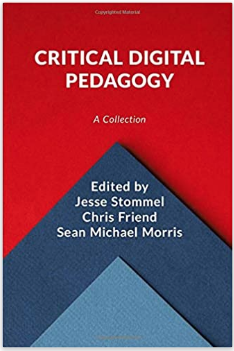
Also noted is that a new text of articles from Hybrid Pedagogy is out - I'm going to order it - always thought provoking reading - even for an old guy nearing the end of a long career like me.

Tuesday, December 17, 2013

Best Practice? and other phrases & words we use ...

A few comments about the words we use.

One of the terms/words we often use in education is 'best practice' ... I have grown to bristle a bit at that one. I know it is just a term we use, however, it gives the impression that there is a set of such practices, you know, the best ones - ones that always work, right? I don't think so, there might be promising practices, or practices that often work ... but I think it is presumptuous to believe that there are best ones. Educators know that context is important. What works in one class or with certain students will not with others. In fact, something that works one day in a certain class may not in the same class on a different day. There are more of these misleading terms we use, most often we know what the person means, but we should try to be more accurate - or misconceptions will occur. In my dissertation, I found that defining 'social media' is also not a clearly defined term - and clarity is pretty important in a dissertation, as I am finding out, what might be clear to one person, raises questions for another - fun!

Oh - one more, the saying that the technology is 'just a tool'. Now I know what folks mean by this, I say it too, however, I think we need to be aware that the tech is much more than just a tool - it can change the way we do things. Cars changed our world in so many ways, computers have too, the way we communicate, research, and create - and they change - or could change - what we do in the classroom. I agree with those who say we need to start with pedagogy, but the tech is not just a mere tool. I don't mean that in a deterministic way - we do have control over how we use the tools, but the tools do affect us. As McLuhan said; 'We shape our tools and thereafter, our tools shape us.'